Setting up a 20,000-layer farm requires more than simply purchasing poultry cages. The cage capacity, house dimensions, equipment layout, ventilation, feeding system, drinking system, and manure management all need to work together.
For a commercial layer farm in Zimbabwe, an open-house poultry farming system can be a practical solution when the farm wants to control investment costs while maintaining efficient daily management.
This project uses 68 sets of layer cages to create a housing solution for approximately 20,000 laying hens.
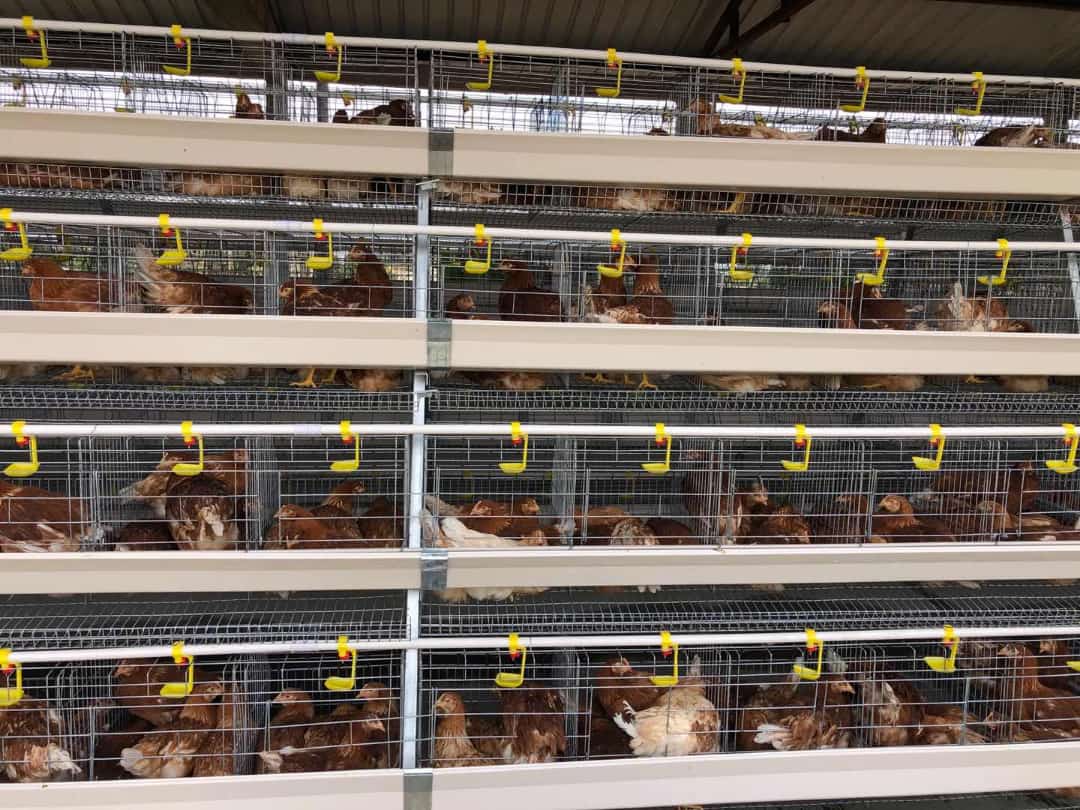
Project Overview
| Item | Project Information |
|---|---|
| Country | Zimbabwe |
| Farm Type | Commercial Layer Farm |
| Capacity | Approximately 20,000 Layers |
| Cage Quantity | 68 Sets |
| Poultry House | Open House |
| Cage System | Layer Battery Cage |
| Main Purpose | Commercial Egg Production |
The 68-set configuration is designed around the farm’s available house space and required bird capacity. Instead of selecting cages based only on price, the layout needs to be calculated according to the number of birds, cage capacity, walking aisles, feeding areas, and equipment space.
Why Choose an Open-House System?
An open poultry house can be suitable for farms in Zimbabwe where the local climate allows sufficient natural ventilation.
Compared with a fully environmentally controlled poultry house, an open-house system can reduce the initial investment in climate-control equipment.
However, this does not mean that ventilation can be ignored.
The poultry house should provide:
-
Good natural airflow
-
Adequate ventilation openings
-
Protection from rain and direct sunlight
-
Sufficient working space around the cages
-
Easy access for feeding and cleaning
-
Proper drainage around the poultry house
The final design should be adjusted according to the local climate, house orientation, and farm conditions.
How Do 68 Cage Sets Support a 20,000-Layer Farm?
The key is to calculate the cage capacity before finalizing the layout.
For example, if one cage set accommodates around 288–300 birds depending on the selected cage specification, 68 sets can provide a total capacity close to the required 20,000-layer target.
The actual capacity should always be confirmed using the specific cage model, tier configuration, and stocking density.
This is important because two poultry cages with the same number of tiers may have different bird capacities.
Basic Equipment Configuration
A 20,000-layer project normally requires more than the cages themselves.
The main equipment can include:
-
Layer battery cages
-
Automatic or semi-automatic feeding equipment
-
Nipple drinking system
-
Manure removal equipment
-
Feed storage and conveying equipment
-
Egg collection equipment
-
Water supply system
-
Poultry house ventilation equipment
The equipment level can be selected according to the farm’s budget and labor availability.
For example, a farm with sufficient labor may use a semi-automatic feeding and manure management system, while a larger commercial farm may benefit from a higher level of automation.
What Should Be Considered When Designing the Poultry House?
The cage layout should be completed before construction or equipment purchasing.
The design should consider:
-
Total number of birds
-
Cage capacity
-
Number of cage rows
-
Central and side aisles
-
Feeding and drinking lines
-
Manure removal space
-
House length and width
-
Ventilation requirements
-
Equipment maintenance access
A common mistake is to calculate only the space occupied by the cages.
A commercial poultry house also needs enough space for workers to operate and maintain the equipment.
Is This Solution Suitable for Zimbabwe?
A 20,000-layer open-house project can be suitable for Zimbabwe when the farm has appropriate land, water supply, electricity, ventilation conditions, and management capacity.
The biggest advantage of this type of project is that the farmer can build a commercial-scale egg production system without necessarily installing the most expensive environmental-control system.
The equipment configuration can also be upgraded later as the farm expands.
Get a Poultry Farm Plan for 20,000 Layers
Every 20,000-layer farm is different.
The final number of cages, poultry house dimensions, equipment configuration, and automation level should be calculated according to the actual project requirements.
If you are planning a 20,000-layer poultry farm in Zimbabwe, provide your poultry house size or available land dimensions. A customized cage layout and equipment quotation can then be prepared based on your project.